Chessmen.
Dead men play war games.
Scroll down for the primer, or skip ahead to a certain section:
✧ Introduction
How often would we fain confess
That life is like a game of chess,
In thought and varied movement;
And looking back it seems so plain
That could we start our game again,
In much, we’d make improvement.
art by DOKTOR
✦ What is a Chessman?
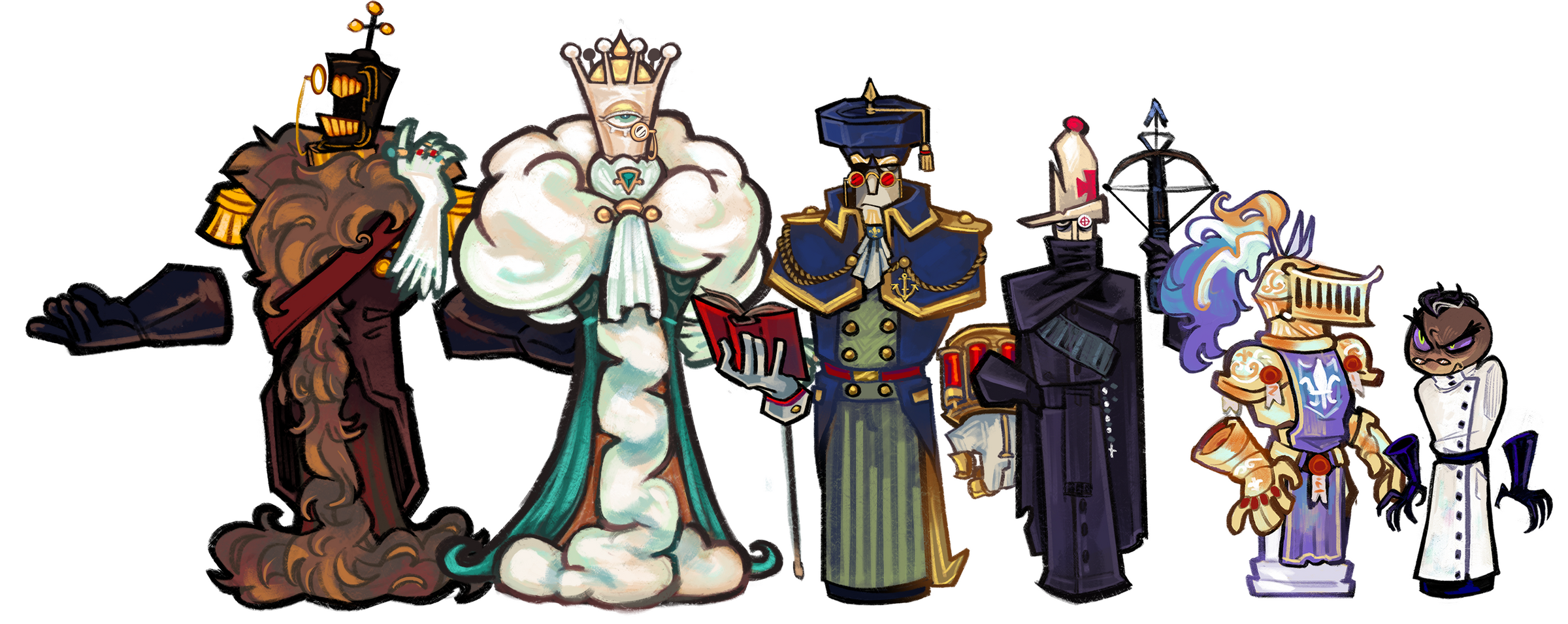
Simply put, chessmen are people that resemble chess pieces. They are anthropomorphized to somewhere around the level of the object people in the Disney adaptation of Beauty and the Beast. They differ primarily in that they are 1. a species, and therefore born like that, and 2. flesh and blood inside.A chessman is a marvel of bio-alchemy. They look like they might be some manner of arcane construct, with their artificial-looking shells, hovering locomotion and detached limbs, but the truth is that their bodies are biological things, and their exteriors are only transmuted to look as if they aren't. Most curious of all, chessmen are ensouled and animated by their own ghosts. That is to say that every single chessman has a history, forgotten or remembered, as a human being who died in any past era of time.The spiritual armatures projected by their souls are known as phantoforms, and the inanimate appearance presented by a chessman's integument is known as a veneer.Where chessmen originally came from, why they resemble chess pieces, and what souls are or aren't most likely to reappear as one are all mysteries that are unknown even to the chessmen themselves.
✧ Fundamentals
✦ Age - Chessmen age at the same rate as humans do, reaching maturity around 18-20 years old. The most common cause of death for a chessman is also their most favorite communal activity: honorable combat. They appear to be able to live forever if they are not cut down, although many of them do begin to exhibit signs of decline at around 650-700 years old. Those that make it so long will often will themselves to pass away, ready to make their peace with death again.✦ Size - Chessman size varies significantly by type as well as by individual.Kings are the tallest chessman, usually reaching about 10 feet in height, while Pawns are the smallest, averaging around 5-6 feet. Bishops and Knights are usually around 5-6.5 feet, Rooks around 7-8.5 feet, and Queens usually reach 8-9 feet.There are exceptions, of course--very tall Pawns and very short Kings do exist for example, but they are unusual and will often be remarked upon.✦ Alignment - As a very hierarchical race, chessmen are usually lawful, and many tend towards good as well, but like any person, they can make choices which put them at odds with their society.✦ Languages - Chessmen can usually speak, read, and write in Old Common, a national language (if applicable in your setting,) and a mothertongue from the chessman's previous human life.
✧ Recollection
Young chessmen begin with no awareness of their past self. As they grow older, they recover their memories in bits and fragments, beginning with their earliest ones, and may start to have Questions for the adults around them.A chessman's relationship with their past self is a deeply personal one. Some of them embrace their histories, treasuring their original names and goals and seeking to accomplish things they never got to do Before. Others prefer to forget who they used to be, and build themselves up as something new. Most chessmen strike a sort of balance in between these extremes, selecting certain things from their past to keep or share, and moving on from the rest. Regardless of this choice, a chessman still has the soul of the person they were, and are: they will be inclined to think and behave the way they used to.Despite each one being the soul of someone who has already passed away, chessmen, curiously, do not share any qualities with any necromantic class of creature. Instead, they bear all of the signs and indicators of a living thing, if an unusual one: reliving rather than undead, if you will.
✦ Society
✧ Culture
Chessmen share human history in common, but also have their own history as a race. People who used to live in very different times and places may grow up together, be in the same family, fight in the same wars, or simply live on the same side of town. There are many mixes and blends of customs from all parts of the world and all points in human history, overlaid with various configurations of chessman tradition.The past lives of chessmen do seem to have some effect on where they are born, but the mechanism is unknown. For example, Pyrania possesses a curious blend of modern, New World and renaissance character while Czechia is predominantly old-fashioned with a distinctly slavic bent. There are plenty of exceptions, but these leanings are significant enough that they have determined the overall character of these nations.
✧ Organization
Like humans, chessmen are fundamentally social creatures, and as a naturally regimented species, they also appreciate structure which compliments their clear hierarchies of strength. Regardless of the type of chessman, they are most satisfied with a cause to serve and protect, whether that is on a small scale or a larger, civil one. Extremely isolated or solitary chessmen are often unwell or unhappy and rarely pursue such lifestyles intentionally. Even the broodiest Knight or coldest Queen will typically have at least one or two individuals for whom they retain some responsibility, if not fondness.Accenting their very military and duty-focused society, chessmen particularly prize loyalty, family and friendship, viewing the strength of such bonds as signs of stability and status.
✧ Hierarchy
Chessmen generally prefer clear order, and will usually arrange themselves (and/or their allies) into a structure with roles and duties if given the chance. Their societies--and militaries, most of all--reflect this. These divisions are decided by capability and readiness to act. Chessmen who are able to handle pressure, make wise decisions and win conflicts honorably tend to be given more responsibility and power by those who desire to be lead by them, while those who prefer direction or parallel operation take positions that best complement their skills and strengths under a commander.When governing themselves, chessmen tend to naturally organize their societies after a sort of feudalism. The layered structure created by vassals and lords, oaths and gifts ensures that rights and responsibilities are easy to track and manageably divided, territorial lines are clear, and duties are obvious.
A Note on Royal Pieces and Power
All types of chessmen can and will accept responsibilities or have them assigned to them, rising through ranks and accomplishing great things just the same. While an individual will always be the piece that best suits them, a person is not their piece type, and chessmen can grow and change in all the same ways a human being in a normal body can!That said, in the same way rulership often seems to fall upon certain kinds of people--different types, throughout the ages, some nobler than others--certain souls with specific personalities will commonly be born as Kings and Queens, and act according to the inclinations they had in life, too, which will often lead them to achieving or retaining similar social positions.
✧ Family
✦ Bloodlines - As such a long-lived race, chessmen families are often large and multigenerational, and they take ancestry seriously--in part because one could very well be alive simultaneously with his great-great-great grandparents.✦ Marriage & Courtship - Chessman society legally treats marriage like an exclusive contract with mutual obligations and a solemn promise of loyalty. These include vows to protect one another, attempt to produce children, share assets and benefits obtained from titles, and, if applicable, uphold each others' obligations to a Lord or Sovereign if called upon to serve. Due to the significance of these requirements, couples tend to bond for life, often after a long courtship during which they prove their virtues to one another.Violation of the vows is considered an extremely shameful form of oathbreaking.✦ Infancy - A chessman begins life as a small egg called a tabiya, with a shiny shell that is either black or white: the opposite of the chessman's primary veneer color. They hatch almost entirely autonomous, with energetic individuals capable of zooming around, mimicking speech and headbutting objects (and people) from day one. It is not unusual for an outgoing infant to begin speaking simple words at only a few weeks old. Since they do not have material limbs, baby chessmen prefer to interact with the world using their heads until they get better command of the phantoform.Over the course of growing up, it is believed that their human souls use memories from their own original childhoods to inform development, changes in voice, and so on.
✧ Houses
Pyrania and Czechia, the two primary chessman countries of origin, are made up of Houses which are responsible for the maintenance and protection of pieces of land and their inhabitants. Just about every chessman belongs to a House, either as a direct member or as a member of a vassal family in service to a House.You can read more about these here.
✦ Anatomy
✧ Shell
The external integument which covers the chessmen and gives them their color. The shell usually resembles a traditional chesspiece material, and (mostly) possesses the physical characteristics of such, but also a unique capacity to move and flex under its own power. In this way, it retains the properties of skin, muscle and exoskeleton without distinctly being any of those things.The appearance a chessman’s shell takes on is called a veneer. Veneer materials vary greatly, from different types of wood, to stone, to metal, bone and so on, but of course they are not truly made of these things. Sufficient damage to the shell will "crack" the veneer, revealing its true character by reverting the damaged areas to a substance which resembles wounded human flesh.All chessmen come in a color that can be identified as either Black or White. This needn't be literally black or white; a pale colored wood reads just as readily as 'White,' and a dark gemstone as 'Black,' for example. In two of the largest chessmen empires, there are two other common colors that are also classified Black and White: in the majority-White nation of Pyrania, native Black pieces are actually Blue, and in Black-majority Czechia, White pieces are Red. In other parts of the world, there may be other colors, too, which likewise correspond to either Black or White.Here are a few examples.





Besides their primary color, some chessmen also have accent hues on their shells. These can be any color in any saturation. Metallics and bright, saturated hues are common accents. An accent color is never present in a quantity that would obfuscate the chessman's base color.Veneer is a strictly chessman quality. It is not influenced by a chessman's original human race, creed, or country of origin. However, it is something that chessmen pass down generationally. Children will usually inherit their color from a parent or a grandparent; rarely they might exhibit 'blended' veneer colors. This correlation has lead to the general distinction between Black and White Houses, being families made up primarily of one color or the other.
✧ Osteon
The structural component of a chessman, the osteon is an articulated internal casing, analogous to bone; it is the skeleton which protects the marrow. Osteon is a little flexible, but also extremely tough.
✧ Marrow
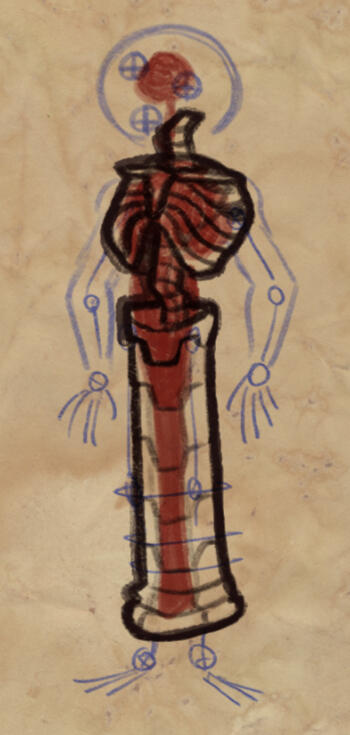
A catchall term for the soft tissues of a chessman's interior, marrow is the material that interfaces most directly with the phantoform, linking its hidden complexities directly to the chessman's body. It is differentiated into various organ structures, all of which contain a jellylike anchor-pulp and liquid blood.Too much loss of blood will render a chessman dormant, but not dead. Extensive trauma to the anchor-pulp however is the one thing that can cause the phantoform to start to detach. If it detaches entirely, the chessman will die.
✧ Sub-Marrow
While "marrow" is the general term for all of a chessman's phantoform-connected insides, chessmen also have numerous, particular organs like hearts and lungs. These connect directly to the phantoform and are reliant upon it to operate.
✧ The Phantoform
The ghostly, half-material projection of the shape of the chessman's human soul. The phantoform is the specter of a human being, with all or most of its parts, including those not visible on a given chessman. Those parts which do exist on the chessman are not duplicated in the phantoform, only animated by it.Phantoforms are very mysterious. Pseudo-material, ectoplasmic and invisible in most circumstances, they can nevertheless interact with physical things, typically in a receptive way, such as through receiving sense data from its intangible organs.Parts of the phantoform which don't have material components already available to them for animation have difficulty interacting with the world directly. The clearest example of this are limbs: no chessman is born with material limbs, but a chessman may link suitably limb-shaped objects to this part of their phantoform to give solidity and strength to, for example, their invisible hands or arms.
✧ Faces
Chessmen have varying facial configurations. Many of them don't have "complete" faces, but all chessman do possess all of the organs of one and their associated senses. It's just that sometimes pieces of them are invisible and mostly intangible, manifested only in the phantoform. For example, an outwardly eyeless chessman can still see, go blind, or require corrective lenses.For reasons that aren't well understood, chessmen can also have all sorts of unusual, non-human facial features as well, and some chessmen have no face at all.
✧ Heads & Crowns
When identifying a type of chessman, it is typically the shape of the head and the crown that will give it away. These rank-indicative parts come in many different styles.
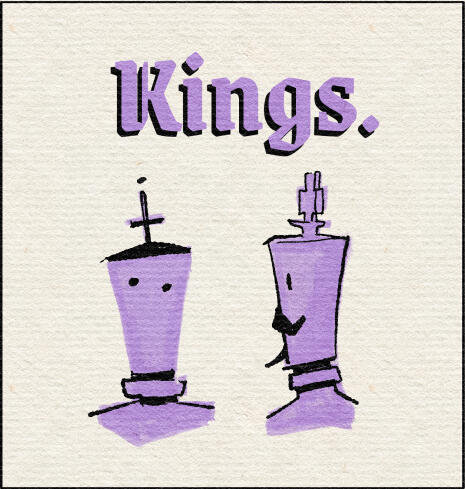
♔ Kings have tall heads, sometimes with a bevel on the top edge and sometimes with a small taper towards the bottom. Their crowns are tall spires, called Finials, and they are often very proud of them. Crosses of all kinds are a very common type of Finial, to the point that sometimes Finials are themselves called 'Crosses'.
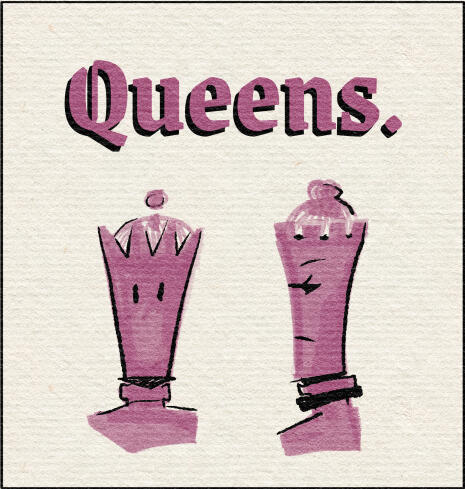
♕ Queens also have tall, cylindrical heads, often with a more pronounced taper towards the bottom half, and always some sort of decorative scalloping around the top edge, within which sits her crown. Their crowns are Coronets: domes with a single, short element in the center, often matched to the scallop.
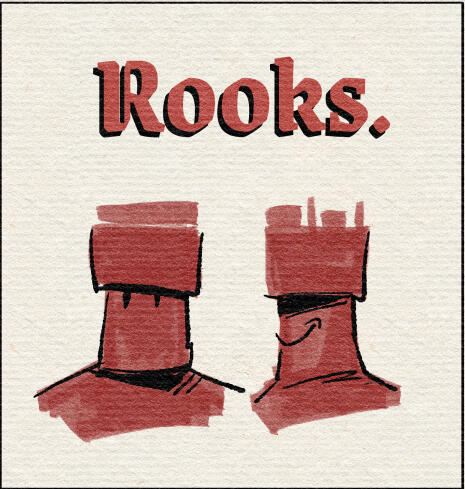
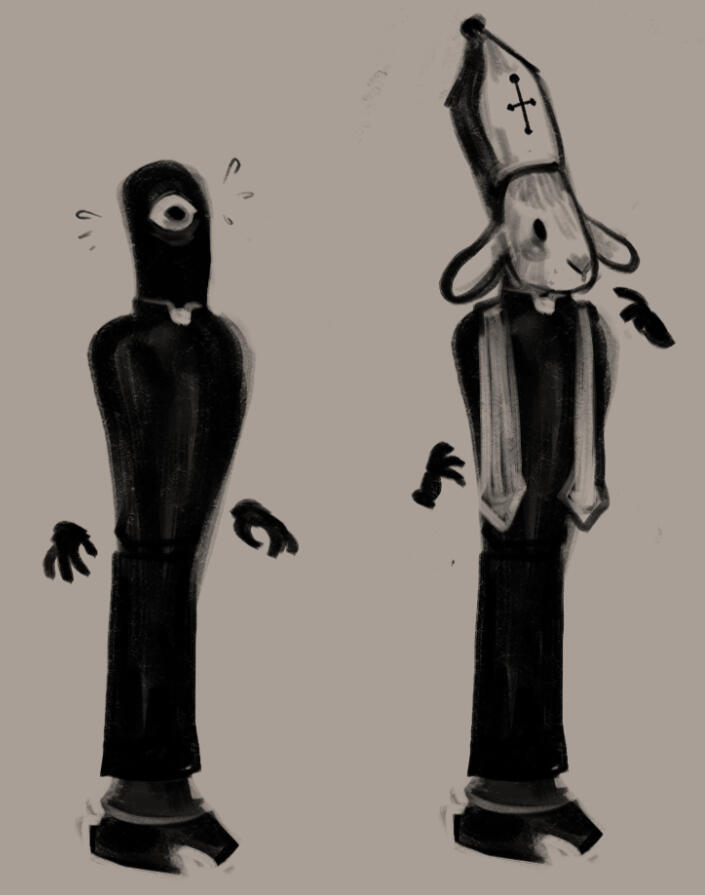
♖ Rooks have shorter, wider cylindrical heads that usually flow seamlessly into their bodies. Their crowns, called Battlements, jut over the head on all sides and resemble defensive walls or other sturdy geometrical structures.
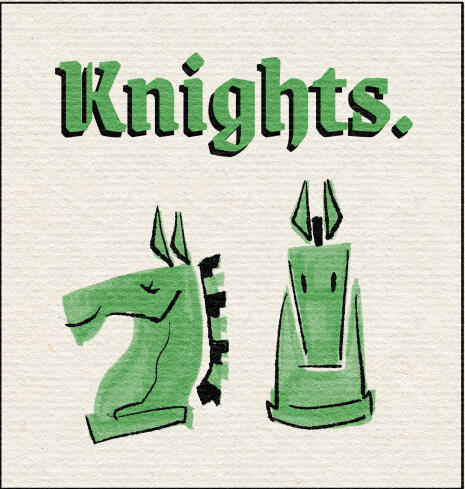
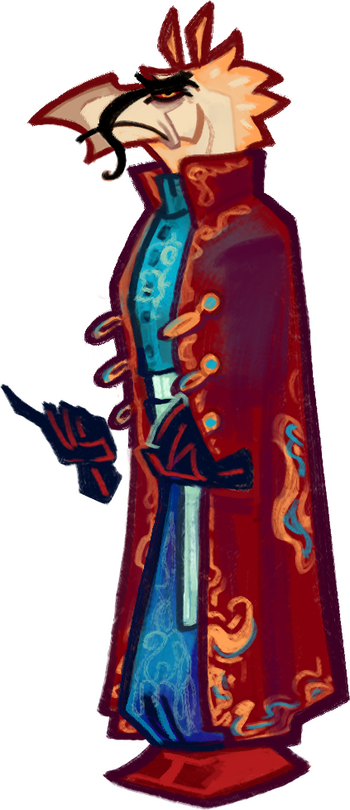
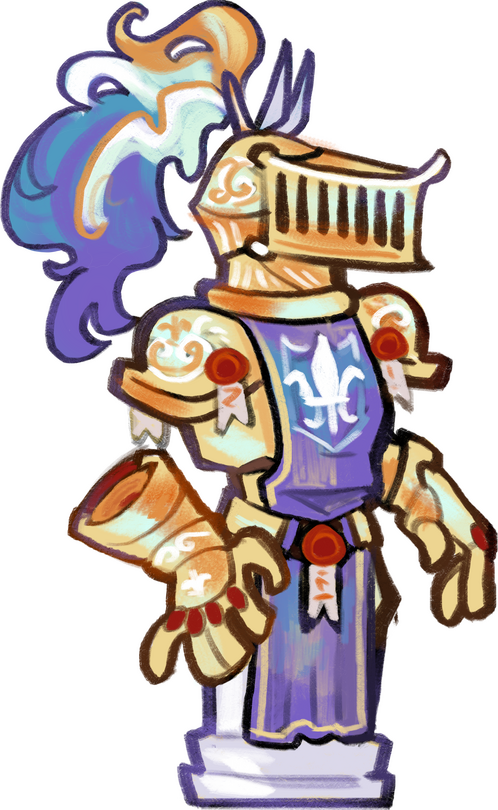
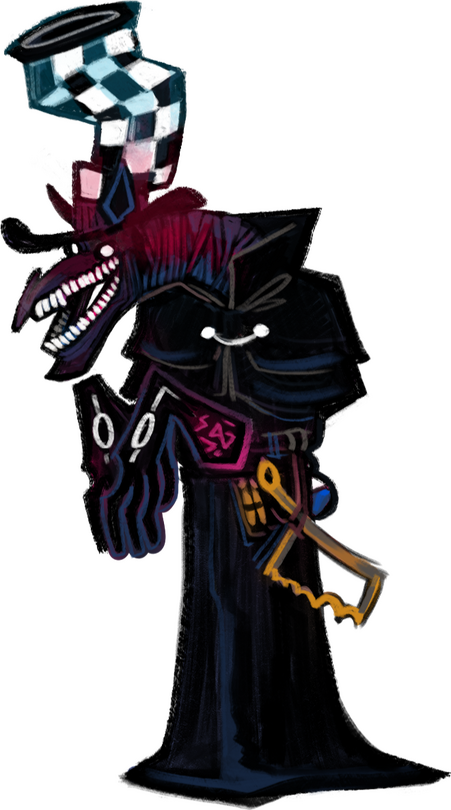
♘ Knights are the only chessmen with a long, muzzle-like face shape. This need not resemble a horse, though it can. Their crowns are their Ears; if they also have a Mane, they will consider that a part of it as well.
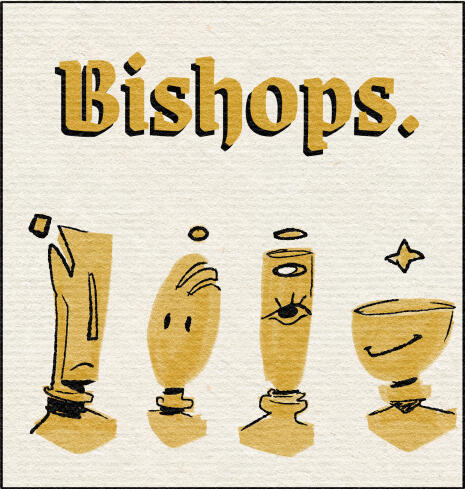
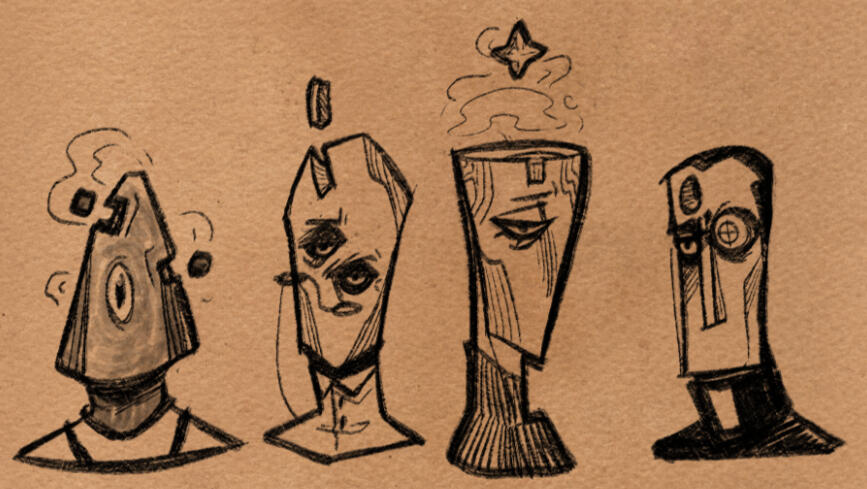
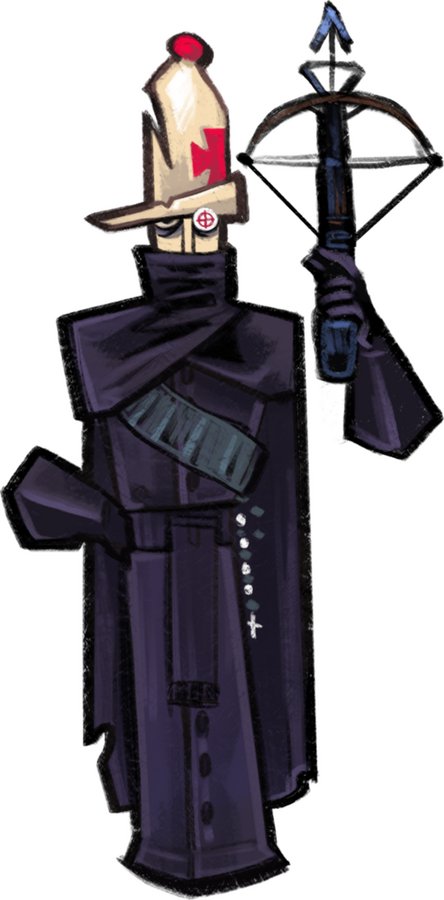
♗ Bishop heads are quite diverse. What unifies them is that each has at least one natural gap in their head, called an Aperture, accompanied by a small hovering Globe. The Globe and Aperture are quite sensitive, and so it is common for Bishops to wear hats to cover them--colloquially referred to as Miters, even when they are not miters at all.
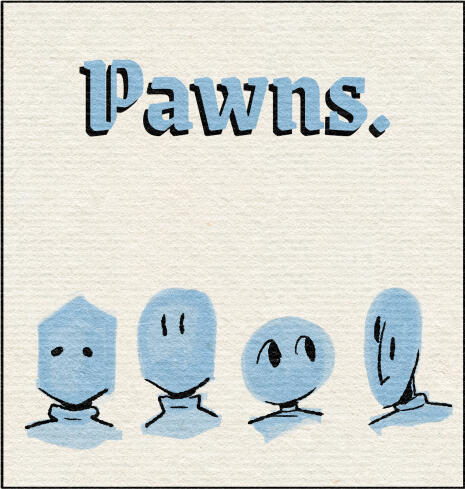
♙Pawns have heads in a variety of compact shapes that are typically round, squat, or both. The most common Pawn head shape is a simple sphere.
They don't need crowns because they are iconic as they are, thank you!
When designing a head or crown for your chessman, think in forms rather than organic shape. It may be useful to take inspiration from architecture or graphic design.
✧ Types of Chessmen
Chessmen can, of course, be one of six types:
Pawn, Knight, Bishop, Rook, Queen, or King.
All of them have an important role to play in society, and all rely on each other.Type determines an individual chessman's general appearance and size, and often indicates a bit about personality and natural inclinations.
What determines the type of piece someone is?
On this subject, two things must be clearly stated:1. Piece type is not hereditary. That is to say, any pair of chessmen can beget any type of piece. A King may be born of two Pawns, or a Rook of a Bishop and a Knight.2. An individual soul who is born as a chessman will always appear as the piece most suited to them. How this is determined is unknown, but no chessman has ever been unhappy with the piece they are, at least not in any deep or lasting way.Pawns do have the unique ability to change their path in life and promote into a different piece, if they desire to (many don't.) It should be mentioned as well that Kings are unique in that they are always born as such, and cannot come from Pawns.
An important note: Piece Names vs Formal Titles
While we mostly refer to these pieces with their common English names, a person's piece and their actual role or title will often be different. For example, many Bishops are not men of the cloth at all, but simple scholars or other people of learning, while many Queens are warriors, mayors, commanders, and so forth, and plenty of Knights have never seen combat and don't care to do so. While the language and culture surrounding these pieces often references their name, it is not synonymous with their position in society; for example, while it is said of King pieces that they often desire 'courts' of trusted advisors, very few King pieces are the actual, civilly recognized sovereign leaders of a country.
♙ PAWN
🜲 Crown: None
↑ Size: 5-6 ft
» Speed: 25 ft
+ Stat Bonus: +1 Constitution or +1 Dexterity
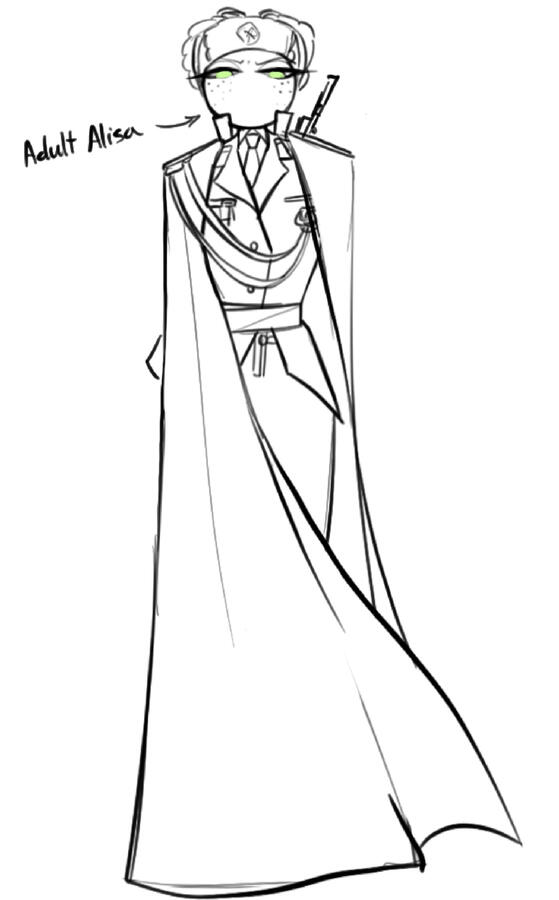
Pawns are the most common and versatile type of chessman, and they are the backbone of chessman society and military forces. They are the smallest piece, but also the most nimble and durable. Pawns are found in all sorts of positions and doing all kinds of jobs. A pawn who feels a certain calling very strongly may one day promote to a different piece, but most pawns are quite happy as they are.
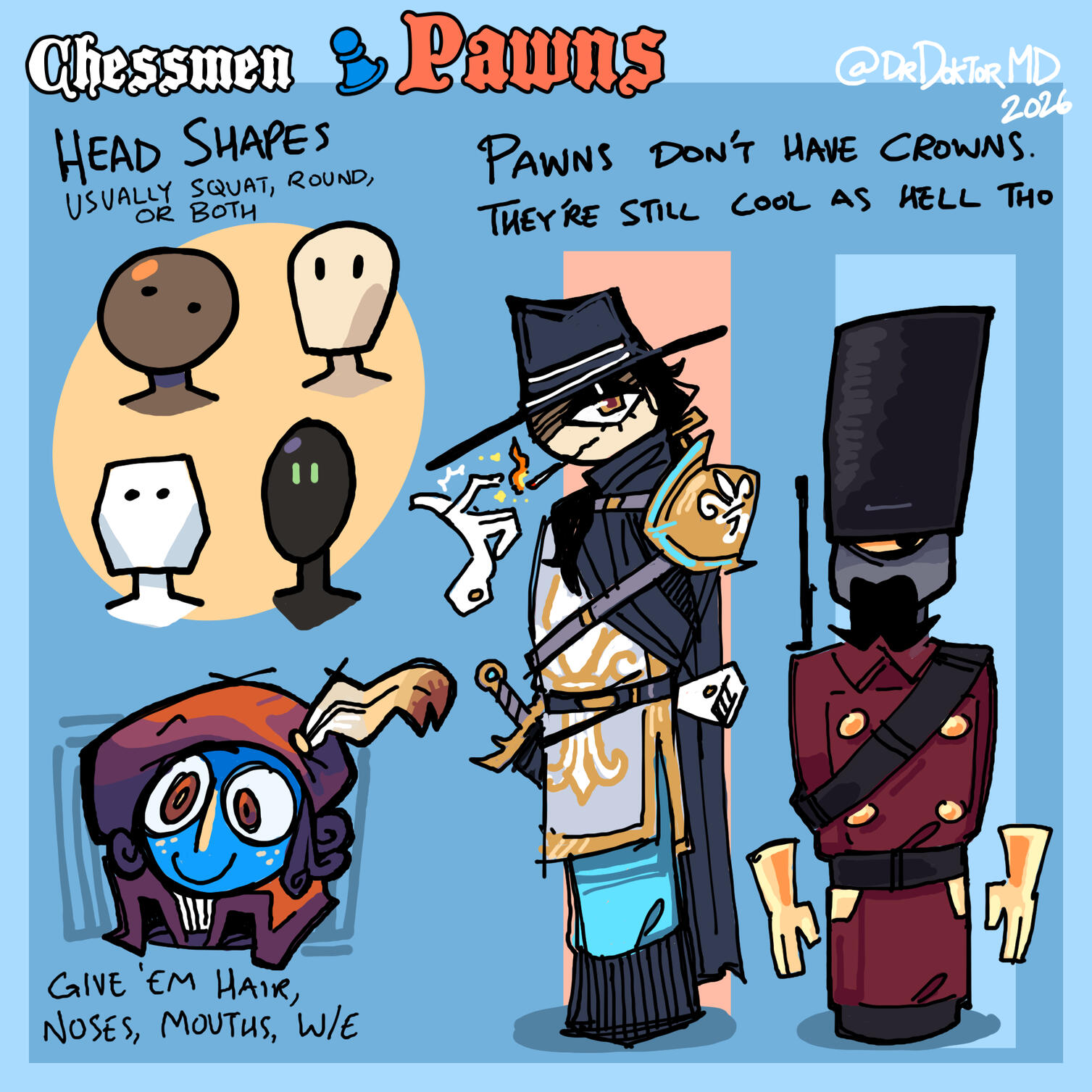
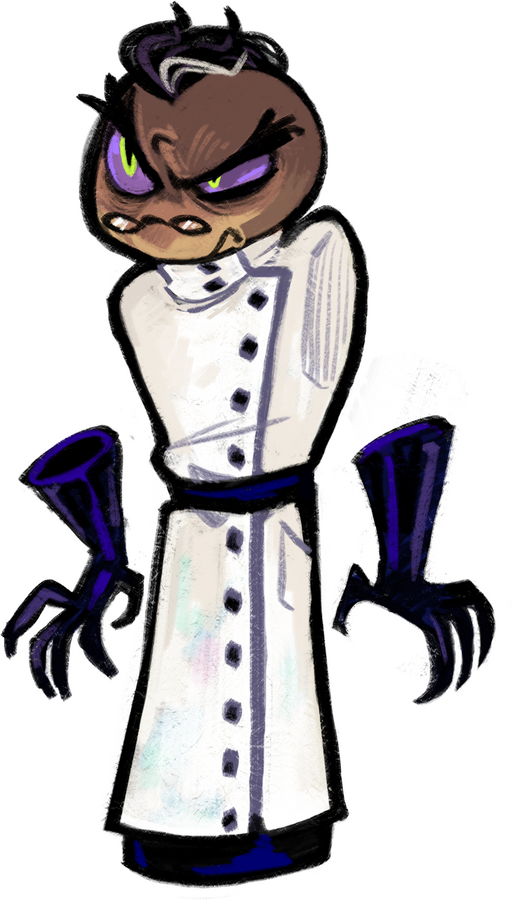
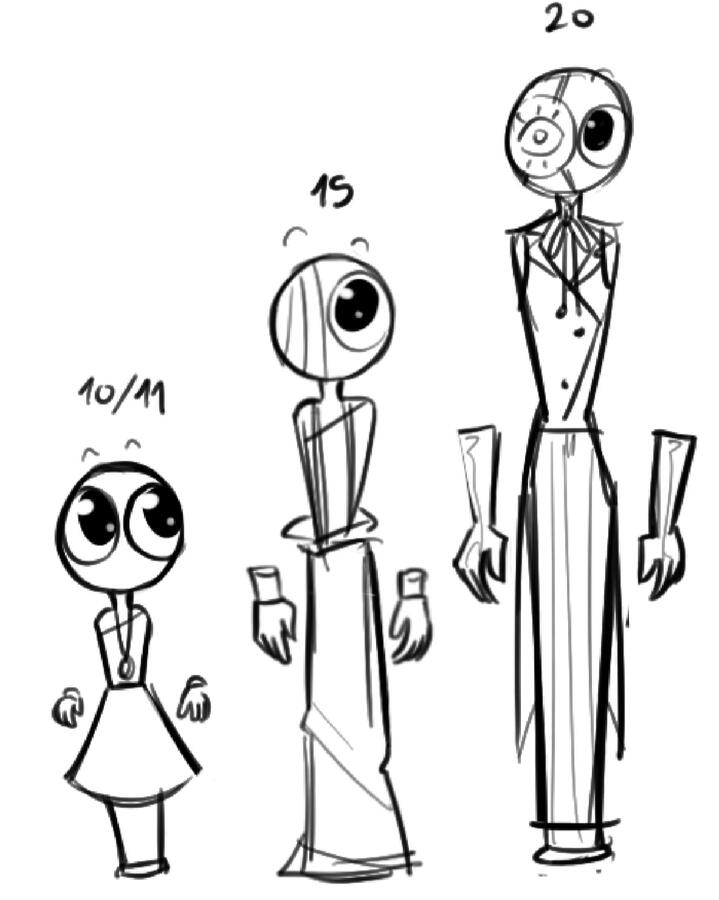

A BIT ABOUT PAWNS
- Pawns are the builders and day-to-day operators of chessman society, and the most varied lot. Most of them have a strong core desire related to achieving something of value to themselves or to the people around them. Someone who is a Pawn is someone that wants to make a difference, and this means that they can and will go to great lengths to achieve incredible things: good or evil.- Even more than the rest of the chessmen, Pawns appreciate clear structure of some sort--even if that structure involves going on a myriad of differing adventures or doing dangerous things. So long as they have some idea of what they are supposed to do next, they can work tirelessly towards all sorts of incredible goals.- That said, while the other types of chessmen tend to keep a focus on a specific vocation, Pawns are extremely versatile. They excel at learning things or accomplishing tasks and then moving on to new fields, transcending genre and old limitations every time.- Pawns who feel especially strongly about a very specific calling might Promote to a different piece once they have begun to fulfill it. This often happens in childhood or at adolescence. Later Promotions are not completely unheard of, but are extremely rare.
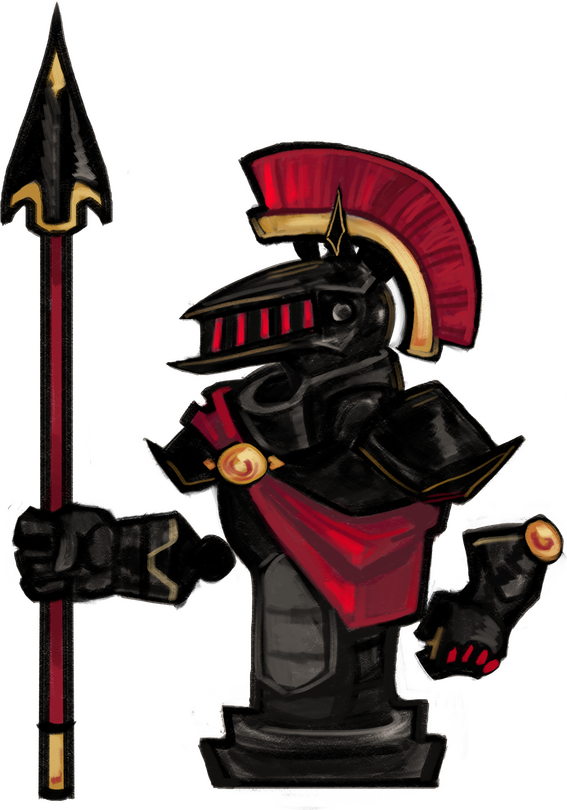
♘ KNIGHT
🜲 Crown: Ears, Mane
↑ Size: 5-6.5 ft
» Speed: 35 ft
+ Stat Bonus: +1 Dexterity
Knights are long-nosed chessmen with the ability to make powerful jumps. They are naturally fit and often athletically inclined. Many knights thrive in competitive environments and love challenging themselves to get better at whatever it is that they enjoy the most. Most of them have a profession, combat style, sport, or game that they toil endlessly to improve at.
art by DOKTOR
A BIT ABOUT KNIGHTS
- Knights are perhaps the most solitary of all chessmen, comfortable doing their jobs or exploring their interests alone. That is not to say that they are not social, but rather that they do not mind operating as one-man units when necessary.- Knights are territorial, but not easily threatened. Someone interested in actively encroaching upon a Knight's domain will often be quizzed or tested ruthlessly, and either humiliated and turned away or accepted as either an equal or potential protégé.- Due to their great dedication to their chosen fields, Knights of a certain temperament often make wonderful mentors. It is not unusual for hermit Knights of some reputation to be sought out by a hopeful, would-be apprentice.- Knights and Bishops are closely related in that their core desire is mastery of a given subject or duty. Generally (but not always,) Knights will have the more active, athletic or martial interests.
♗ BISHOP
🜲 Crown: Globe & Aperture
↑ Size: 5-6.5 ft
» Speed: 40 ft
+ Stat Bonus: +1 Wisdom
Bishops are a magically-inclined type of chessman, capable of constantly absorbing small amounts of ambient mana which they can then use to empower everything from their wounded allies to their oratory skills. They do this through the Apertures on their heads, phantoform-filled gaps that serve as both highly sensitive extrasensory organs and mana collectors, tempered and channeled through Globes--free-floating spheres attuned to the individual Bishop, which serve as a sort of innate magical focus. In order to avoid painful overexposure to stimuli, Bishops tend to cover their heads with their signature miters (which can in fact be other, non-miter hats.) They are often scientists, scholars, priests, advisors or spiritual leaders.
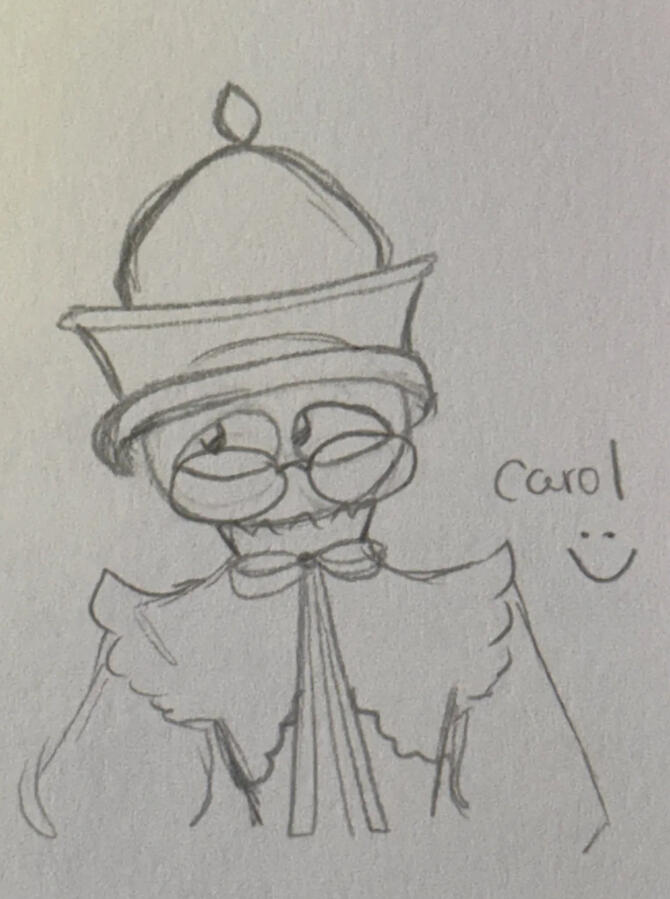
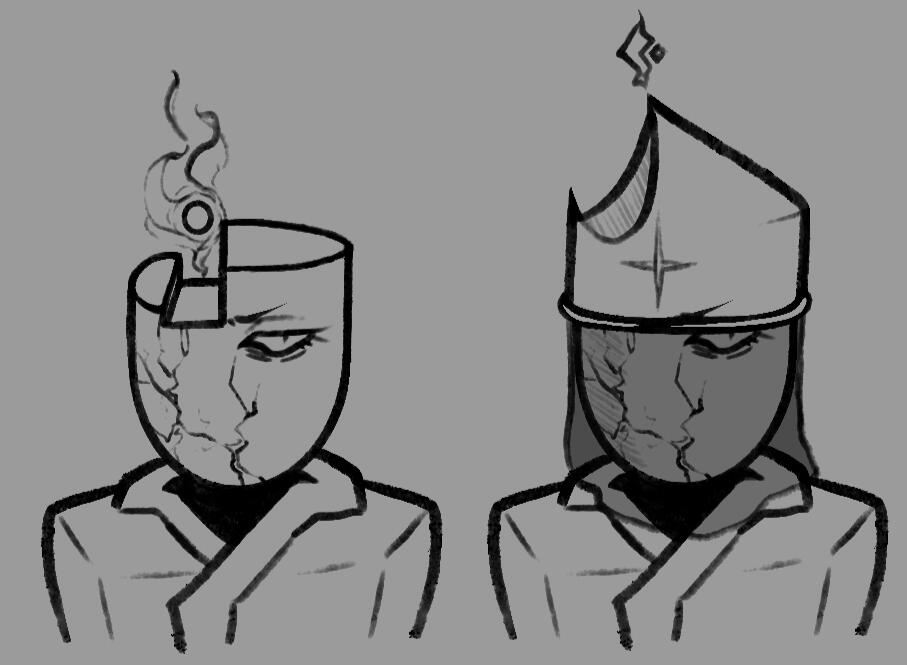
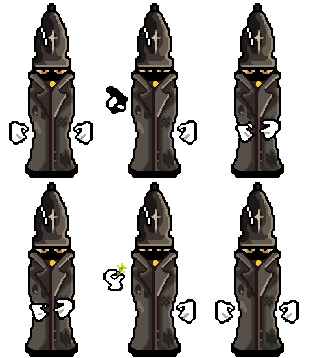
art by DOKTOR, Tutti, JustMoonPie, Bren
A BIT ABOUT BISHOPS
- The core desire of a Bishop is usually to Know Things. This makes them very good at everything from reconnaissance to study. Some Bishops turn this desire towards higher things, studying philosophy and metaphysics; others desire to know more about the world itself, becoming scientists and students of nature, magic and history. Certainly there are also Bishops who like to know other peoples' business, becoming spies or intelligence-gatherers, and still others, like Knights, love to know all there is about a specific subject of interest.- Bishop Apertures vary greatly, not just in appearance but also in function. Some Bishops may receive strong spellcasting prowess from theirs, while others may gain the sharpening of their senses, the ability to see ghosts, minor innate telekinesis or telepathy, thermal vision, or the ability to sense magic so finely that it can practically be seen.- In addition to the above, all Bishops have some minor natural ability to tap into their own ambiently gathered mana. Even without study, they can cast one or two simple spells.- Knights and Bishops are closely related in that their core desire is mastery of a given subject or duty. Generally (but not always,) Bishops will have the more academic, arcane or subtle interests.
♖ ROOK
🜲 Crown: Battlement
↑ Size: 7-8.5 ft
» Speed: 35 ft
+ Stat Bonus: +1 Strength
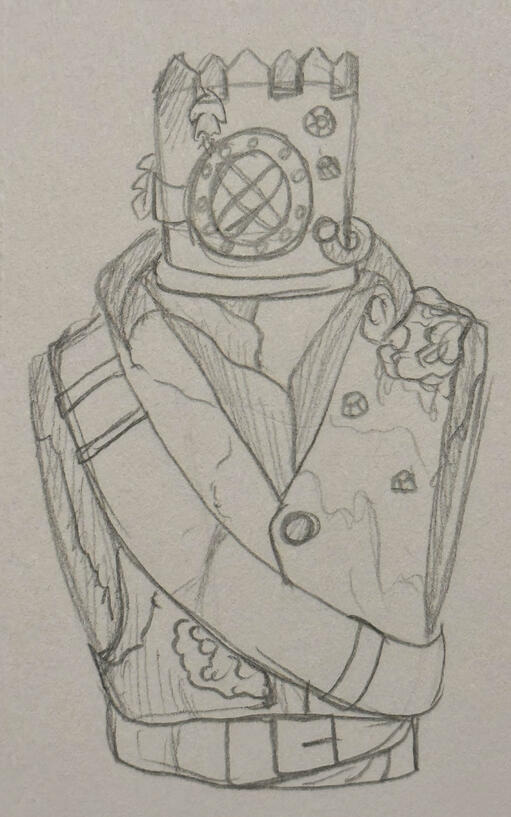
Rooks are large and sturdy, and are the strongest type of chessman, with a reputation for great loyalty. Because of their size, they are commonly found in positions like engineer, smith, soldier, guard or laborer--anything at all that needs a bit of brawn to get done, and sometimes things that don't; and because of their fidelity, they are sometimes instead or additionally invested with the duties of counsellors, advisors, keepers of secrets, and protectors of precious things.
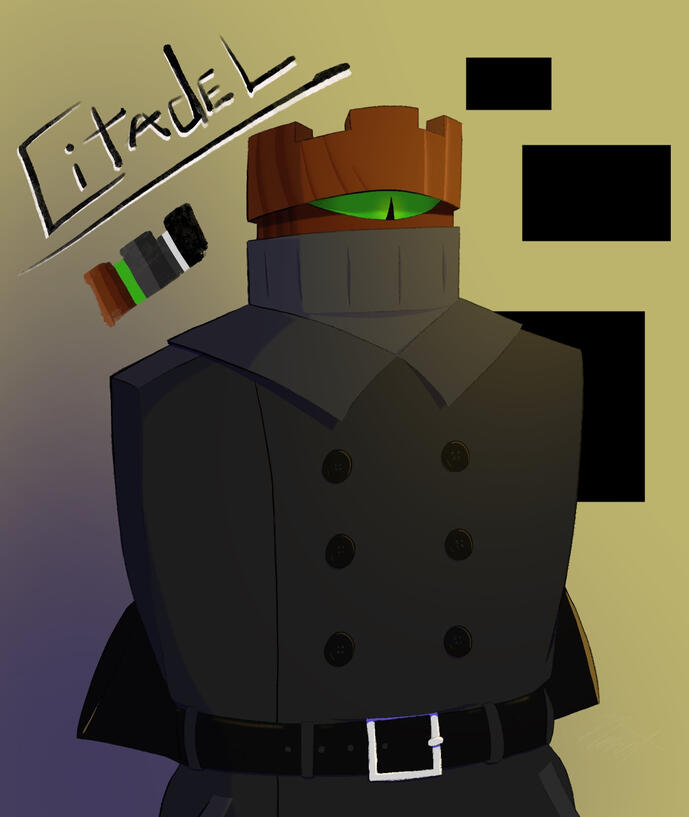
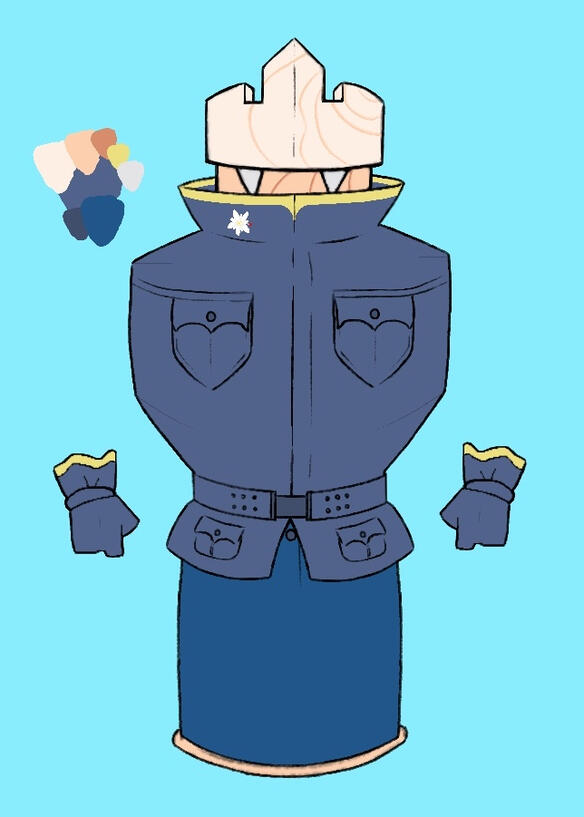
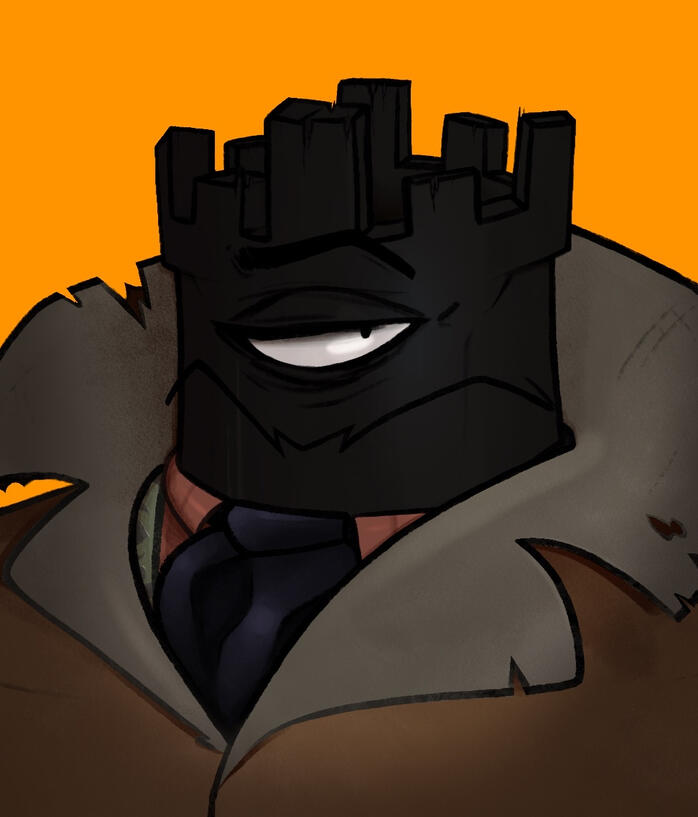
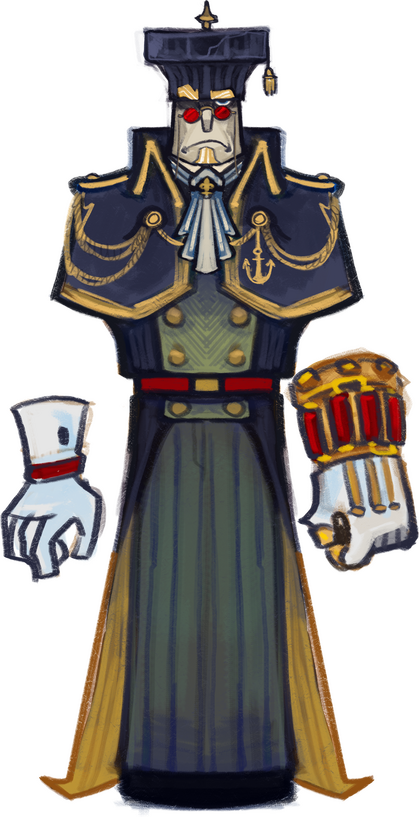
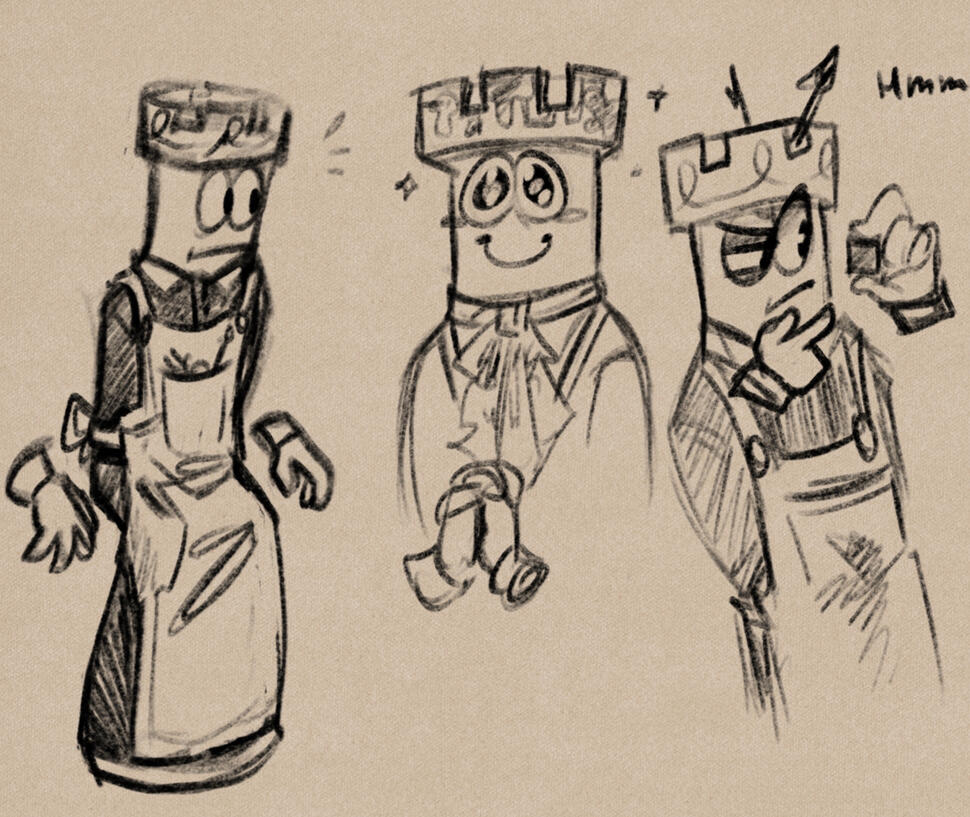
art by JustMoonPie, DOKTOR, Tutti
A BIT ABOUT ROOKS
- Stout-hearted and sturdy, Rooks prize and desire stability, and often work to keep it. If there is a comfortable status quo, they will be the first to defend it, and if change must come, they would rather that it be accomplished in a measured and reliable way.- That is not to say that Rooks are incapable of surprises--many of them harbor plenty--only that, even when there is chaos, a Rook would rather be in control of it in some way than at its mercy, or at least in a position to manage it.
♕ QUEEN
🜲 Crown: Coronet
↑ Size: 8-9 ft
» Speed: 40 ft
+ Stat Bonus: +1 Intelligence
Queens are the second largest chessmen, with a reputation for being both effective and cut throat in their fields of interest. Many of them hone themselves into powerful combatants, capable of protecting their homes and loved ones with terrifying grace and ruthless efficiency.Those who prefer to operate on subtler battlefields are commonly strategists, executives, generals and managers of large holdings or social bodies. Despite their fearsome reputations, Queens typically have either a very magnetic charisma or some other form of personal, powerful authority that inspires people to join them in the pursuit of their vision.Queens are always female.
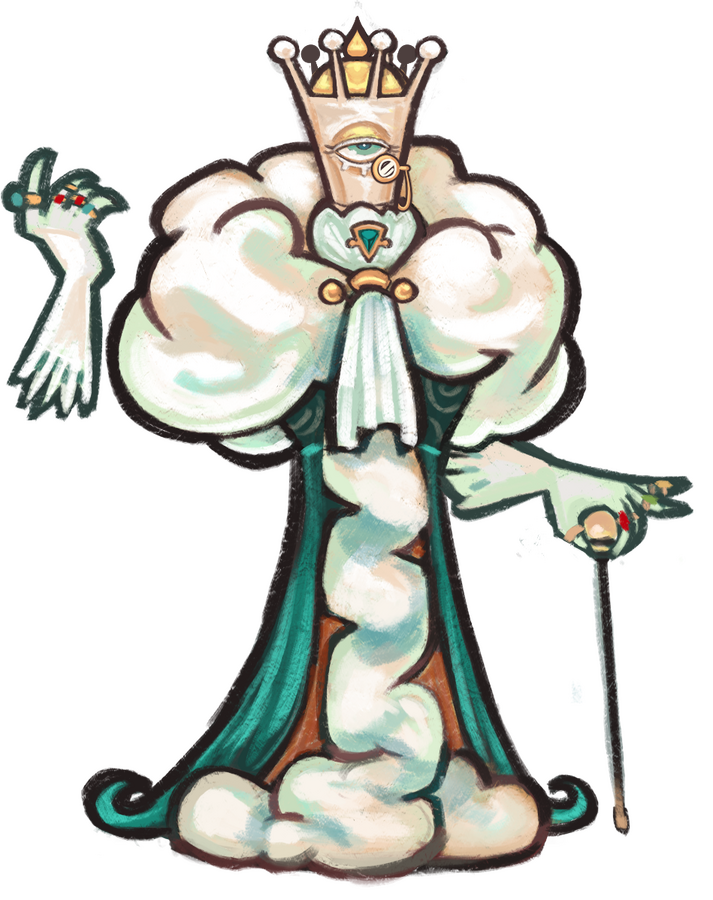
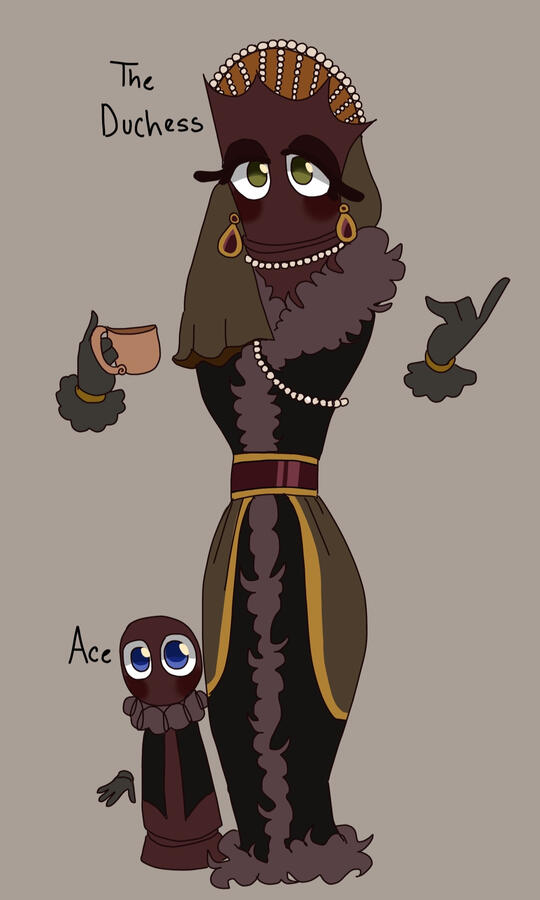
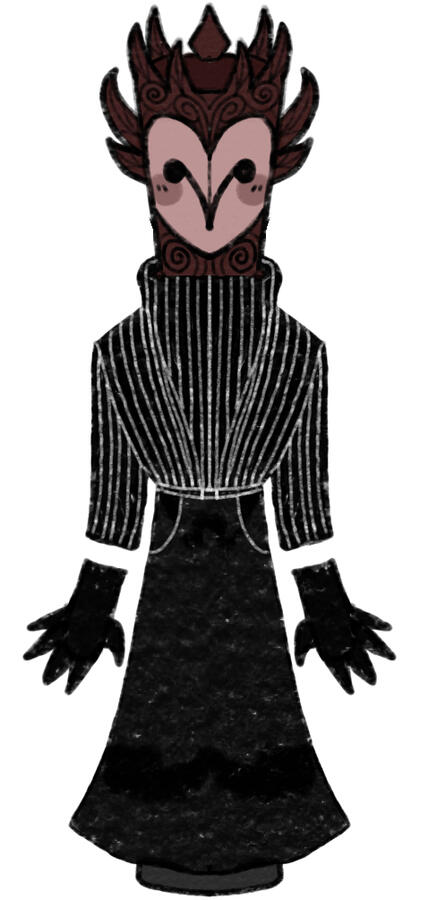
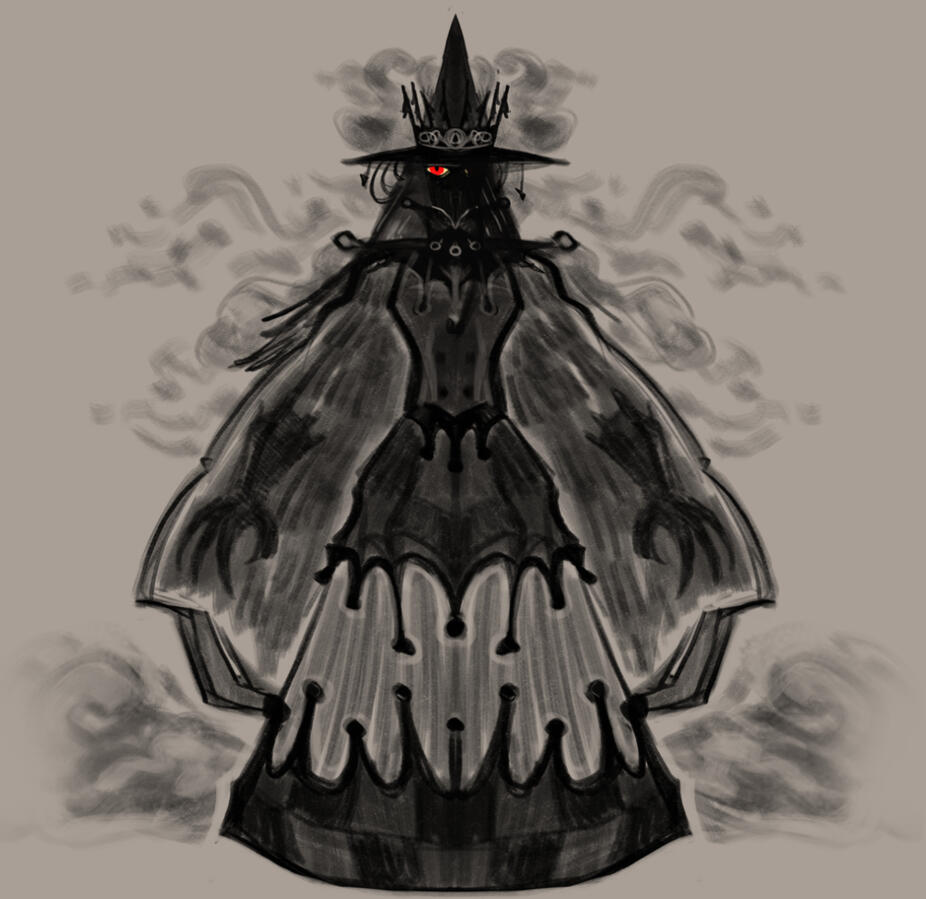
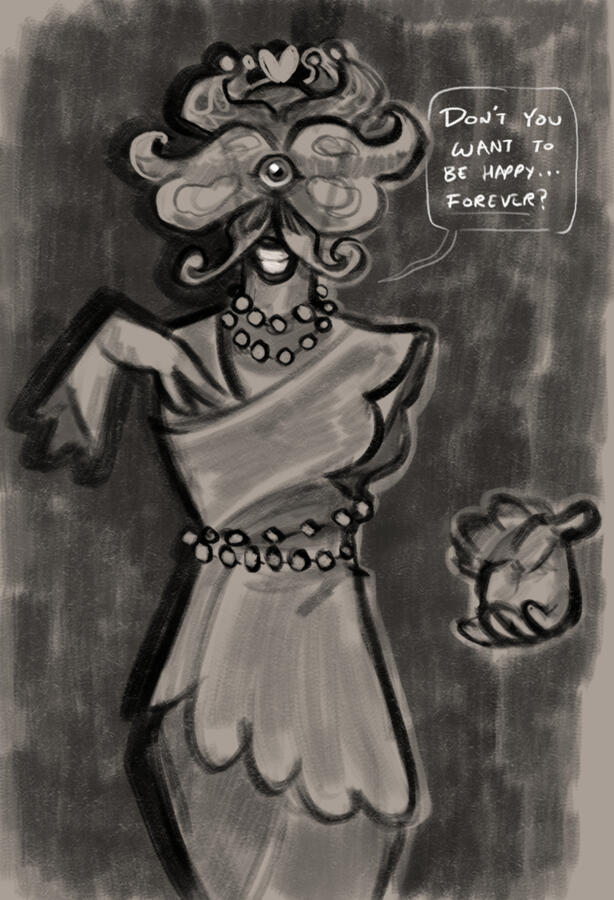
art by DOKTOR, Lemon, Sooterkin
A BIT ABOUT QUEENS
- The core desire of a Queen is to cultivate and protect social structures (and, sometimes, individuals) that they consider worthy of their attention. This could be an institution or company, a nation, a single person, or several of these. Well-established Queens (>150 years old) will often have several "projects" that they attend to simultaneously.- Queens are known for personal efficiency and competence, and they will often express it as lone agents. "Alright, I'll do it myself" is a common sentiment.- Even more martial-oriented Queens are naturally inclined towards magical practice and usually exhibit an aptitude for a specific kind when they are young. (Promoted Queens will gradually come to access such power as they grow older if they did not already have it as Pawns.)- Despite their prowess in amassing and managing people to accomplish a goal, Queens are often more solitary than Kings, keeping only very small circles of trusted friends.- A Queen that has adopted a King--be he a spouse, a family member or a promising protégé--will typically add his area of influence or sphere of order into her own list of projects.
♔ KING
🜲 Crown: Finial
↑ Size: 9-10 ft
» Speed: 25 ft
+ Stat Bonus: +1 Charisma
Kings are the largest and slowest type of chessman. Natural born leaders, they are the anchors around which other chessmen tend to congregate, the pillars of society itself. A good King is noble, wise and fatherly and makes use of his command and resources to ensure his people are fulfilled. They are often judges, commanders, tacticians, and directors; in whatever role they take, they are the establishers and symbols of the law and order that other chessmen strive to uphold, and the chief executors of that law.Kings are always male.
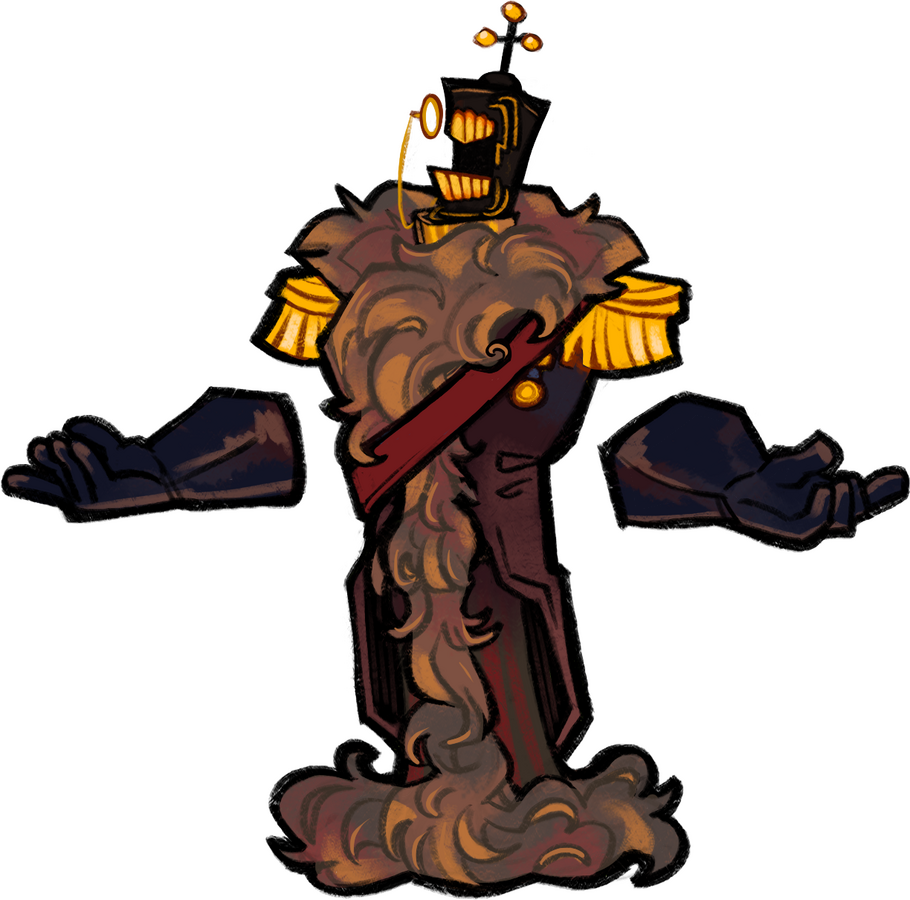
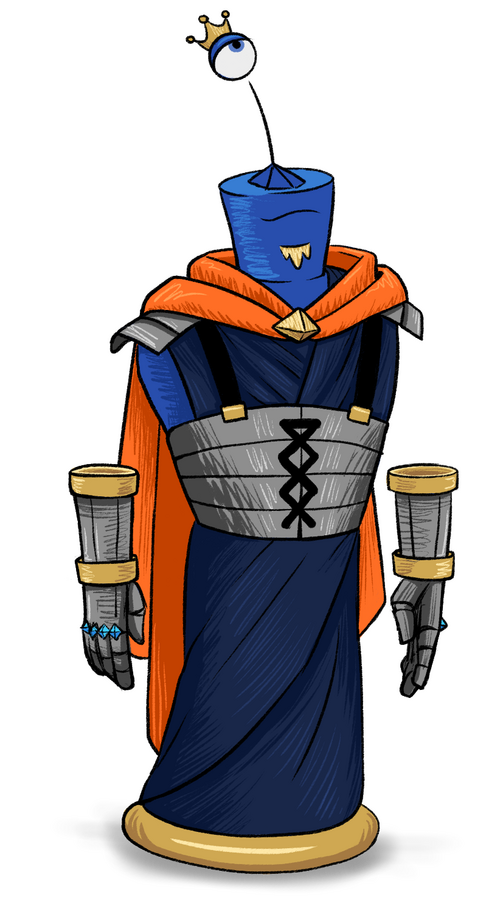
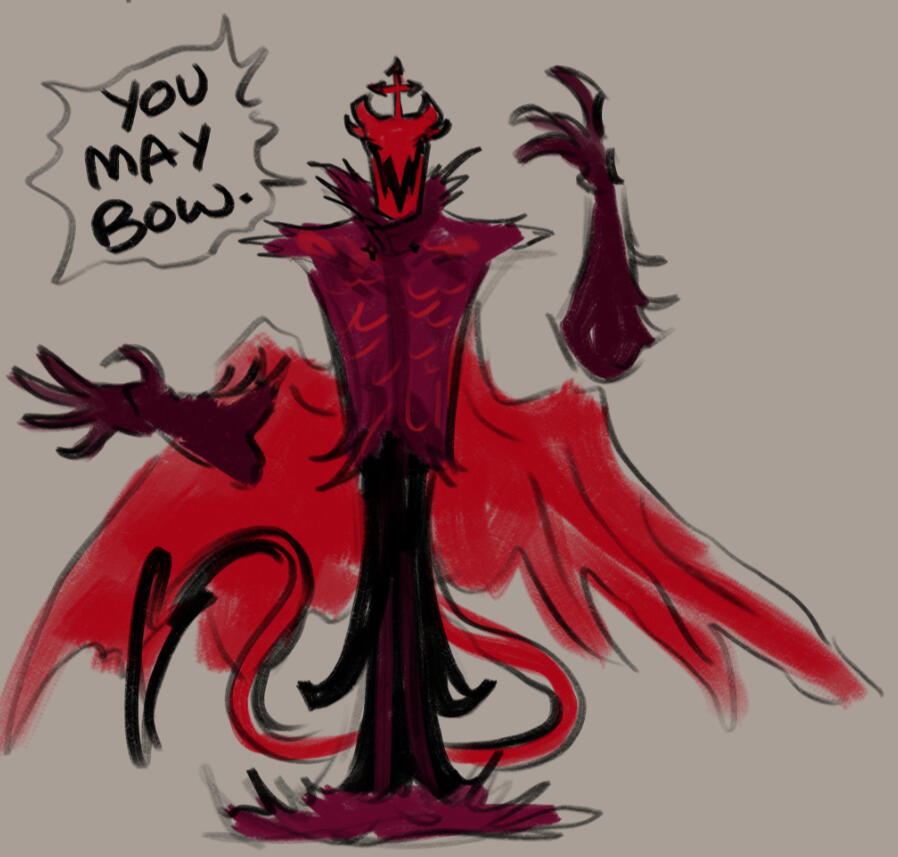
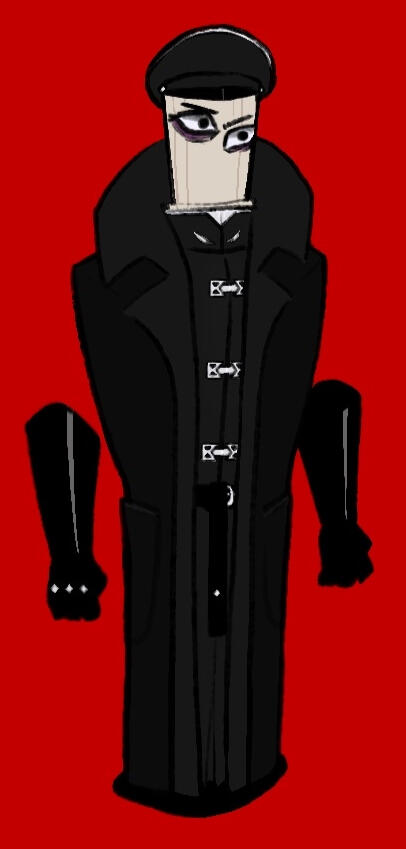
art by DOKTOR, NefariousNeutron, JustMoonPie
A BIT ABOUT KINGS- The core desire of a King is to establish and keep a social order which he believes is good and profitable to himself and his people. He trusts his own judgment, even when it might be erroneous or flawed. A wise King will listen to advisors without allowing them to supplant his own instincts and turn him into a puppet; a weak King will not listen to advisors at all, only himself. The sort of man that would let others make all the choices for him does not typically appear as a King piece, but sometimes it happens when such a soul becomes negligent or lazy in the carrying out of the duties he has secured for himself.- Kings are very social and often charismatic and inspiring in some fashion, which they use to build a court--whether it is a formal, actual court or simply a circle of trusted friends upon whom they can rely. It need not always be a grandiose sort of charisma. Many Kings are quiet men, but they are never dull.- Unlike Queens, Kings do not have any natural magical aptitude, although sometimes a very old one might master a few spells with minimal study. Their power is instead socially generated and then developed in arenas of grit, wit and wisdom, derived from their charisma and willingness to accept the burdens of authority and responsibility that few others desire, and, most crucially, from the will of others to follow them.- While this is not always true, Kings who have been adopted by a Queen will often do nearly anything to avoid losing her interest and patronage. Nearly.
✦ Realms
✧ The Board
This is a species document as opposed to a larger lore repository, but place of origin is key to, well, the board game of chess, and therefore to chessmen as well! Herein are some sketches of a few places you may wish to call upon for inspiration, which may be the subject of their own documents in the future. If you desire to insert a chessman into an alternative setting, of course, feel free to disregard everything written below.The world to which chessmen are native has a number of sovereign nations, but the two with which we are primarily concerned are Pyrania in the West and Czechia in the East.A couple of honorable mentions include:
The dune kingdoms of Istach, which form a large province of the Czechian Empire.
The Devil's Spine, an island chain off the western coast of Pyrania, rife with illegal activity.
The Murmur Zones, dangerous bubbles of bizarre paranormal activity which defy the laws of reality and provide infinite quantities of valuable resources, making them important territories.
✧ The Black & White Houses
The old chessman High Houses are domains of noble lineage and allied families who claim some great service done to the rebuilding of the world and continue to serve her people in some way. Any chessman is able to pledge allegiance to one of these, becoming a vassal in exchange for a clear and honored place in society.
Chessman Houses are basically very large families of various degrees of nobility, which is decided by past and present military leadership, controlled territory and, commonly, contributions or favor gained with royal Houses.Pyrania is made up of what are historically known as the White Houses and their holdings, while Czechia is comprised of the united Black Houses. Before the establishment of these countries, the Houses often warred against one another for land and resources. Some old grudges are still alive...Those operating with the House structure typically fall into one of these ranks:
Sovereign, being the head of a country and its constituent body of Houses;
Lord, being the head of a House sworn to the service of a Sovereign;
Vassal, being one who is sworn to the service of a Lord in exchange for the use of land and protection;
and Freeholder, being one who holds land without being sworn to any particular Lord or House, and retains the position of citizenship.Any vassal is entitled to pursue the acquisition of a personal piece of land from a ruling House through military service. Commoners with no landed obligation are required to obey the law but otherwise may do whatever they please.The Houses themselves can be split into four categories:
Royal Houses, Great Houses, Vassal Houses and Independent Houses.✦ Royal Houses are Houses descended from a reigning monarch, possessing the right to rule. They are often very old, very rich, and usually very powerful in some particular field. When it is time for the country to wage war, it is this House that gathers troops and support drawn from the Great and Vassal Houses and organizes them into an army.✦ Great Houses are noble families that rule major territories within a kingdom, holding titles and the right to grant parts of their lands to vassals, as well as the responsibility to protect them.✦ Vassal Houses are enitre families that have been granted lands and protection by a Great or Royal House in exchange for support, taxes and combatants, if called upon.✦ Independent Houses are those which have no loyalty nor responsibility to any Great or Royal House and do not identify themselves as such a House, either. They are often based in isolated locations where they can neither be besieged nor compelled into service.
The Royal and Great Houses are named and documented, with specific cultures and holdings, but there is an effectively unlimited number of Vassal Houses, being chessman families in the service of one of the above.
✧ Pyrania
The kingdom composed of the old White Houses, Pyrania is known for its beautiful countryside and the biophilic design of its architecture. Its culture blends rural Americana and Western European aristocracy into an atmosphere that is simultaneously elegant and down-to-earth.
In Pyrania there are five Great Houses. At least one Independent House has also taken up residence on an island in the Devil's Spine.
👑 ARMENTARIUS, House of Lands (AR-men-TAR-ee-yus)Cowboys, farmers, conservationists, and general lovers of life in all its forms. Armentarius is the ruling House of Pyrania, and is also called the House of Kings because of not only this, but also its long documented history of producing an unusually high number of King piece chessmen.
✧ VETRA, House of Skies (VEH-tra)Aircraft, weather, flight, and exploration of the peculiar and endless Skies above the world are the domains of free-spirited House Vetra. Pyranian airspace is well protected by their flying fortresses.
✧ LEVENTIS, House of Tides (lev-EN-tiss)House of seafarers, naval combatants, shipbuilders, bankers, merchants, portmasters, treasure-hoarders and high seas adventure seekers. Leventis likes to present a strict, stuffy front of formality and uprightness, but everyone knows they're just salty seadogs underneath.
✧ ORMAESTRIS, House of Hands (or-MAY-stris)Technophiles, engineers and scientists who like to look at impossible things, go "let's do it anyway," and deal gladly with the inevitable explosions. Pyrania's #1 Code Violators.
✧ YSGOL, House of Scribes (is-GOAL)A House full of historians, antiquarians, scholars, librarians, archivists, clerks, and documentation enjoyers. House Ysgol records everything, often in triplicate. It is said that their children are all born able to read and write.
✧ Czechia
The empire made up of the Black Houses, as well as a few additions conquered over the centuries. Czechia has an old world Eastern European character, majestic and mysterious outside of the walls of its sturdy civilization, and known for its long, bitter winters.
👑 CZAROCH, House of Structors (ZAR-rok)Engineers, fortress builders, architects, quarry owners, city planners, rail designers, and also the royal House of Czechia. The Empire could not be so large or well managed without excellent infrastructure, and House Czaroch are the lords and masters of infrastructure.
✦ MAKSTRID, House of Thunder (MACK-strid)Soldiers, delvers, mercenaries, blacksmiths, armorers, and producers of weapons and war machines of every kind. Makstrid thrives on conflict, their coffers full of the spoils of old victories and of the profits earned from the process of securing it.
✦ GHEATAH, House of Physick (GEE-tah)An old House of doctors who blend traditional medical wisdom with modern knowledge, and who strive to master many anatomies, not only that of the chessmen. Many of the best physicians in the world were trained by Gheatah, if not born into the House directly.
✦ ELEGIAX, House of Venators (el-LEE-GEE-ax)Hunters, butchers, landkeepers, cemetery protectors, missing persons finders, ghost custodians and singers of dirges. Half of House Elegiax are monastics with a long tradition of entering battlefields to bury the dead after war. The other half are warriors sworn to protect them. Members of either will, sooner or later, start to see the spirits of the dead.
✦ DAG GIZOTH, House of Knives (DAG giz-OTH)Once masters of dark wizardry and every eldritch power, the last Lord of Dag Gizoth and his family have since gone mad, and the House has fallen into the hands of a crafty usurper known as the Warlock. Now, Dag Gizoth deals not only in black magic, but also black markets, courting thieves, scoundrels and deep devilry as readily as it does sharp minds.
✧ Istach
The jeweled crown of the Sea of Sands, Istach was once the second largest chessman empire, now subsumed into Czechia as a collection of provinces and governed through an appointed council that answers to the Czar.It is a large collection of territories mingling Persian influences with hundreds of varied local cultures.
📜 HAZAKHAR, House of Swords (ha-ZAKH-ur)A horde of wandering warriors who live and die by blade and honor, binding and commanding spirits to aid them in combat.
📜 ALHAWEZ, House of Change (al-HAW-ez)The royal alchemists of Alhawez are wise philosophers, clever scientists and brilliant physicians. They once traded lore and artifacts with Dag Gizoth, and have the largest surviving collection of tomes written by the old sorcerers of that House.
📜 VAXSH UR, House of Seers (vaksh-OOR)A reclusive but powerful House of oracles, mages and strategists in good standing with the djinn empires.